October, Not December: The Best Month for the Northern Lights in Tromsø Is Not the Busiest One
October gives Tromsø 2.04 expected usable hours a night against December's 1.34, and December has the least usable sky of the whole season. Statistics Norway's returns show December is now the busiest month in Troms: 154,890 hotel guest nights against October's 123,895.
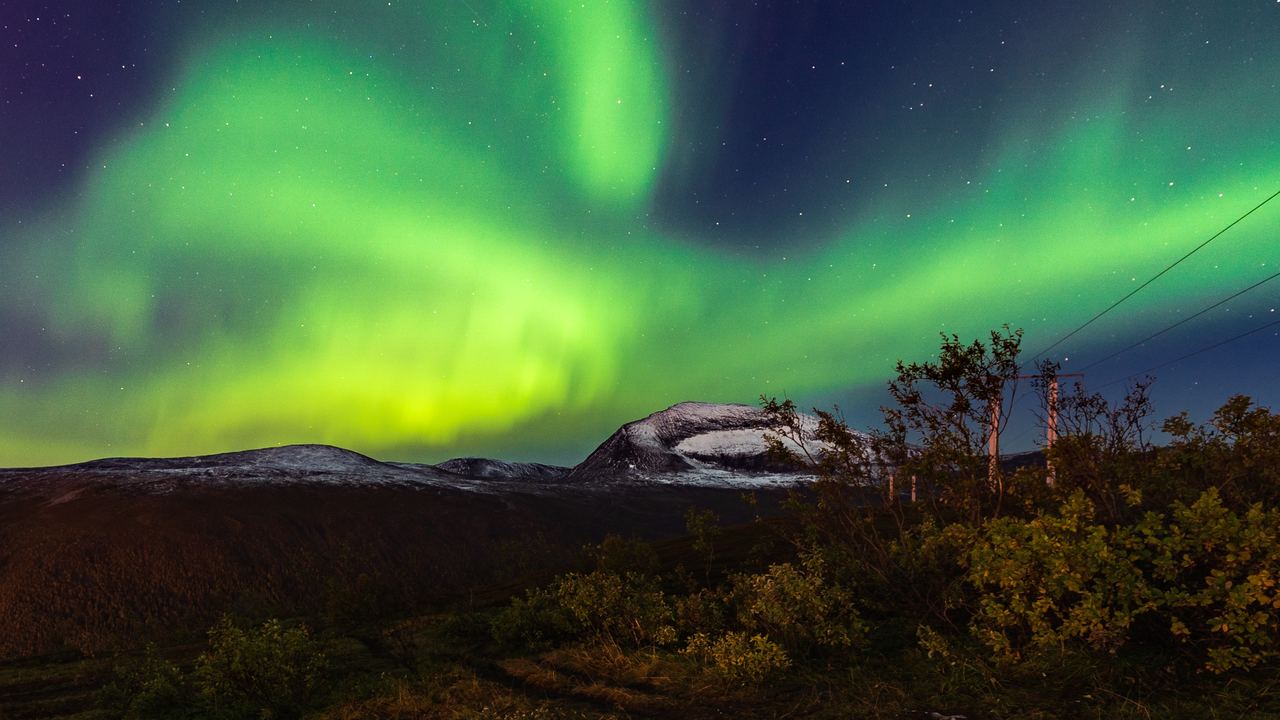
The best month for the northern lights in Tromsø is October. The month people book is December. Both of those sentences can be checked, and they come from different places: the first from eleven seasons of cloud reanalysis, the second from Statistics Norway's accommodation returns.
In 2025, hotels in Troms county recorded 154,890 guest nights in December and 123,895 in October. December was the busiest month of the entire year, ahead of every summer month. In 2019 it ranked seventh, and July was first. Somewhere in the six years between, the Arctic winter stopped being the quiet half of the calendar in northern Norway and became the main event.
This article was planned around the claim that December is Tromsø's worst month. Our own numbers do not support that, so here is the correction before the tables start. September is worse, and March is close behind. What December is, measurably, is the weakest month of the ones people actually travel for, and the month with the least usable sky in Tromsø's whole season.
Two things have to happen on the same night
An aurora you can see needs a gap in the cloud and a sky dark enough for the light to register. Those two conditions do not move together through an Arctic autumn. They move against each other, and that is the whole argument of this article.
Cloud is the one almost nobody publishes. We take it from ERA5, the European reanalysis, over eleven seasons from September 2015 to April 2025, and count a night as usable when it has at least two hours with cloud cover at or below 50 per cent between 18:00 and 02:00 local time. Those thresholds are ours, they are choices rather than facts, and they belong next to the number every time it is printed.
Darkness is the easy one, because it is arithmetic rather than statistics. Astronomical darkness means the Sun sits more than 18 degrees below the horizon, and for a given latitude and date it is exact and stays exact. We compute the average hours of it inside the same 18:00 to 02:00 window, which is roughly when tours run.
Multiply the two and you get a figure we call expected usable hours: the share of nights with usable sky times the hours of real darkness in them. It answers the question the two tables cannot answer separately, which is how much aurora can physically fit inside a night in that month. The method behind both columns is set out on our guide page about when the sky actually opens.
Here is Tromsø's season with both constraints on the same row.
| Month | Nights with usable sky | Darkness per night | Expected usable hours | Three axis index | Nights without moon |
|---|---|---|---|---|---|
| September | 34.0% | 1.8 h | 0.61 | 0.71 | 17% |
| October | 31.9% | 6.4 h | 2.04 | 2.27 | 48% |
| November | 20.0% | 7.9 h | 1.58 | 1.51 | 50% |
| December | 16.8% | 8.0 h | 1.34 | 1.07 | 58% |
| January | 23.5% | 7.9 h | 1.86 | 1.61 | 58% |
| February | 23.3% | 6.7 h | 1.56 | 1.58 | 57% |
| March | 28.4% | 3.5 h | 0.99 | 1.19 | 39% |
October is the best month for the northern lights in Tromsø
October wins both columns that combine the constraints. On expected usable hours it scores 2.04, the highest of Tromsø's seven months. Once the geomagnetic term is added it scores 2.27, and December falls to 1.07. On that second measure October is worth more than twice December.
The reason is in the first two columns. October still holds 31.9 per cent of nights with usable sky, within a couple of points of September's annual high, and by then the darkness has arrived: 6.4 hours a night, against September's 1.8. September has the open sky and no night to put it in. December has eight hours of darkness and almost nothing to look through. October is the few weeks where both are present at once, and it is the only month in Tromsø's year where that is true.
This is not a Tromsø quirk. The same thing happens at Alta, Bodø, Kiruna, Akureyri, Abisko and Anchorage, where October or November takes the top of the row. Two months carry the best skies in northern Scandinavia, and neither of them is the one the Christmas packages are built around.
September has the open sky and no night to put it in. December has eight hours of darkness and almost nothing to look through. October is the few weeks where both are present at once.

What December actually wins, and it is not nothing
An argument that only runs one way is usually hiding something, so here is December's case, made with the same tables.
December has the most darkness available anywhere in the season. Eight hours out of eight in our window are full astronomical darkness, which is the maximum the measurement can return. Tromsø's polar night runs from 28 November to 14 January on the standard −0.833 degree threshold, 48 days during which the Sun does not clear the horizon at all. You are not waiting for dusk to finish at four in the afternoon.
It also has the better moon. 58 per cent of December nights are free of lunar interference against October's 48 per cent, on our threshold of average disturbance below 25 per cent. That threshold is another of our choices. A full moon well up the sky will wash out a weak aurora; a full moon that has already set does nothing at all, which is why the calculation looks at where the Moon is and not only at how full it is. The detail is on the guide page about moon, darkness and the nights worth booking.
For this October the new moon falls on the 10th and the full moon on the 26th. The first half of the month is the darker half.
None of that rescues the month, because the cloud is a bigger effect than either. December keeps 16.8 per cent of nights with a usable sky. Eight hours of darkness behind an unbroken overcast is eight hours of nothing, and that is the trade the month makes.
Why December feels like the right month for the northern lights
The intuition is reasonable and it is half correct. Long nights do help. The mistake is treating darkness as the binding constraint when in northern Norway it stopped binding in early October and the cloud took over.
There is a second strike against December that almost nobody mentions, and it has nothing to do with weather. On the GFZ Potsdam Kp and ap series, which runs from 1932 and covers 94 complete years, December is the weakest month of the year for geomagnetic activity, 20.4 per cent below the annual mean measured on mean monthly ap. October sits 11.0 per cent above it. March and September are the two peaks, 19.4 and 17.5 per cent above, which is the Russell-McPherron effect and the reason the equinoxes behave the way they do.
So December is the quietest month on the magnetometers, the cloudiest month over Tromsø, and the busiest month in the hotels. The three facts are unrelated to each other, which is what makes the coincidence worth printing.
We should be careful about how much weight that geomagnetic term carries. It is a climatological average across 94 years, not a forecast for this December, and the spread between a quiet year and an active one is far larger than the gap between two months. It shifts the odds. It does not decide a night.

The booking figures, and the year they changed
The claim that December is the month everyone books is easy to assert and worth checking, so we pulled it from the source. Statistics Norway publishes hotel guest nights by county and by month in its StatBank, open and without registration, and we queried table 14166 directly on 7 October 2026.
Troms county, total hotel guest nights, December against October:
| Year | October | December | December as a share of October | December's rank in the year |
|---|---|---|---|---|
| 2016 | 83,502 | 92,659 | 1.11 | 7th |
| 2017 | 85,029 | 97,268 | 1.14 | 7th |
| 2018 | 89,877 | 104,098 | 1.16 | 6th |
| 2019 | 99,573 | 106,679 | 1.07 | 7th |
| 2024 | 123,847 | 137,947 | 1.11 | 1st |
| 2025 | 123,895 | 154,890 | 1.25 | 1st |
The ranking column is the part we did not expect. Before the pandemic, December was an ordinary month in Troms and July was the busiest. In both 2024 and 2025 December was first outright, and in 2025 it beat the second placed month, March, by more than 22,000 guest nights.
Restricting the query to holiday and leisure stays, which strips out business travel and conferences, sharpens it: December 2025 recorded 112,556 leisure guest nights against October's 78,506, a ratio of 1.43. The month with Tromsø's thinnest sky takes roughly 43 per cent more leisure business than the month with its best one.
We are not claiming all of that is aurora traffic. Christmas in the Arctic sells on its own, the figures cover a whole county rather than the aurora tours inside it, and nobody asks arriving guests what they came for. What the series does establish is the shape of demand, and the shape is a December peak that did not exist seven years ago.
December in Troms, year by year
December hotel guest nights, from Statistics Norway table 14166. The years 2020 to 2023 are missing: the county was merged with Finnmark then, and the figures do not compare.
The origins
December 2014
63,734 guest nights
The starting point. December is an unremarkable month in a county whose tourism year peaks in summer.
December 2016
92,659 guest nights
Up 45 per cent in two years. October that year records 83,502, and the two months are still close together.
The growth
December 2018
104,098 guest nights
December passes a hundred thousand for the first time, and ranks sixth in its own year.
December 2019
106,679 guest nights
The last fully comparable pre-pandemic December. July is still the busiest month of the year at 121,470, and December is seventh.
Today
December 2024
137,947 guest nights
December is now the busiest month in Troms, ahead of February and of every summer month. The ranking has inverted.
December 2025
154,890 guest nights
The highest monthly figure in the series, and 2.4 times the December of eleven years earlier. October the same year: 123,895.
| 1 | 2 | 3 | 4 | 5 | 6 | 7 | 8 | 9 | 10 | 11 | 12 |
What this means for the number of nights you book
Picking the better month does not buy you a short trip. It makes a short trip less of a gamble, and the difference between those two is where most of the disappointment in this trade comes from.
Cloudy nights in Tromsø arrive in runs rather than independently. On eleven seasons the unconditional chance of a usable night is 25.4 per cent; after a usable night it is 44.3 per cent, and after a closed one it is 19.1 per cent. Weather has memory, so the familiar arithmetic of one minus 0.75 cubed is wrong, and it is wrong in the optimistic direction.
Run it properly, with a two state chain fitted to that persistence, and three nights in Tromsø across the season come to 51.2 per cent for at least one usable sky. In December the same three nights give 40.0 per cent. Reaching 90 per cent takes eleven nights across the season and fourteen in December. We worked through that calculation when we asked how many nights you actually need in Tromsø.
One honest gap: we have not computed the equivalent composite for October alone. The published tables cover the full season and December, and extending them needs the cloud series rerun month by month. October will land above the seasonal 51.2 per cent on a three night stay, because its marginal rate is higher than the seasonal average, but we are not going to print a figure we have not calculated. That is the whole argument of this site pointed back at ourselves.
What to do with this if you are already booked for December
Book more nights than you would in October, and treat the first clear evening as the one that counts rather than waiting for a better one later in the week. Our figures say the better one frequently does not arrive.
Pick an operator that drives. The statistics on this page are for a fixed point, and they understate a tour willing to cross into Finland or run 200 km down the coast to get out from under the cloud. That mobility is the single thing a December booking is buying, and it is worth more in December than in any other month.
What these numbers do not say
Every figure above has an edge, and the edges belong in the body rather than in a footnote.
Usable sky is not aurora seen. The cloud figures describe whether you could have seen a display, assuming one was overhead and you were looking at the right moment. They are a ceiling. The real rate sits underneath it, and we do not know by how much.
ERA5 is a reanalysis on a grid of roughly 28 km, not the weather station at the end of the road. It is the standard instrument for climate questions and the wrong one for a valley microclimate.
Expected usable hours multiplies two monthly averages together. It is not a joint distribution, it assumes nothing about whether clear nights and dark nights travel together, and the three axis index makes the same assumption about geomagnetic activity. Neither column is a probability, and we have tried not to write them as though they were.
The thresholds are ours. Fifty per cent cloud, two hours, an 18:00 to 02:00 window, 25 per cent mean lunar disturbance. Move any one of them and the table moves with it. We publish them so that somebody can disagree with them specifically rather than in general.
And nothing in any of this accounts for temperature, road conditions, or how long a person can actually stand still outdoors, which after an hour of waiting stops being a detail. October is colder than its photographs and a great deal warmer than December. For how the rest of the season compares across destinations, there is the guide page on the best time to go.
Aurora tours in Tromsø that chase the sky
The four most reviewed aurora excursions in our Tromsø catalogue that advertise neither a success rate nor a sighting guarantee. All are chases, ordered by number of reviews.
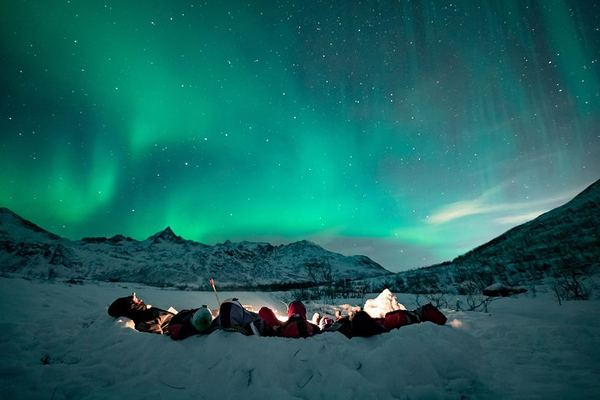
Tromsø Aurora Hunt with Bonfire, Hot Meal, Thermal Suit and Photos
Thermal suits out, campfire lit and a hot meal served while you wait. The guides set up your camera, and their own photographs reach you free afterwards.
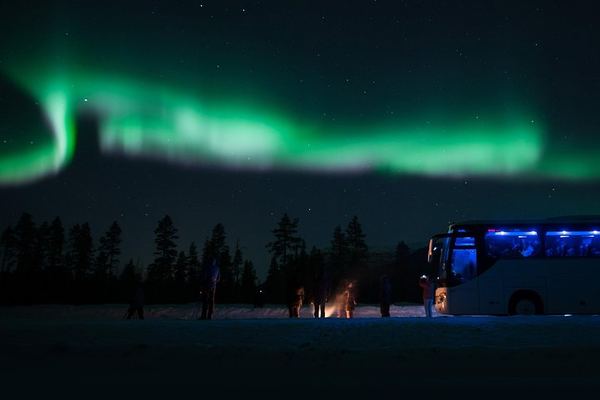
Northern Lights Big Bus Chase from Tromso with Chasing Lights
The budget chase, and honest about it: clear sky comes before scenery, some stops are roadside, and the route can cross into Finland. Dress in layers.
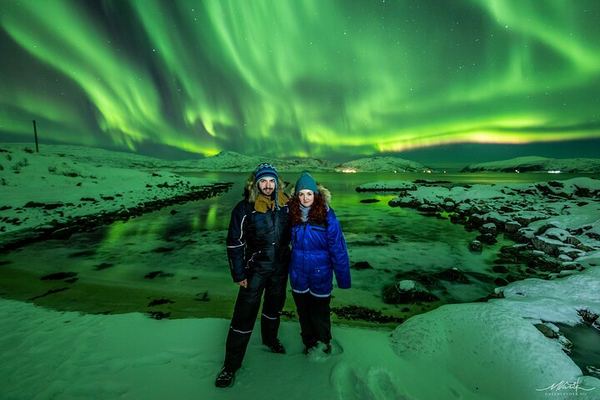
Northern Lights Adventure with Greenlander, Maximum 8 People
A working chase in a modified 4x4 Mercedes: hot meal, tripods, thermal suit and aurora portraits. Expect snow underfoot and a genuinely late finish.
Northern Lights Minibus Chase from Tromso with Chasing Lights
The minibus version of the chase: a smaller group, more room to change plan mid-evening, and a route that follows cloud and road, sometimes into Finland.
Ratings collected by Viator and Tripadvisor
Questions people ask about October and December in Tromsø
Is October a good month for the northern lights in Tromsø?
It is the best month of Tromsø's year on both measures we publish. October holds 31.9 per cent of nights with usable sky and 6.4 hours of astronomical darkness per night, giving 2.04 expected usable hours against December's 1.34. With the monthly geomagnetic term added it scores 2.27 against December's 1.07.
Is December really the worst month in Tromsø?
Not of the whole season. September is worse on expected usable hours, 0.61, and March is close behind at 0.99. December is the worst of the months people travel for, and it does have the least usable sky of any month in Tromsø's season at 16.8 per cent of nights.
Why do so many people go to Tromsø in December then?
Long nights are an intuitive proxy for aurora chances, and Christmas in the Arctic sells by itself. Statistics Norway's figures show December is now the busiest month of the year in Troms county, 154,890 hotel guest nights in 2025 against 123,895 in October. Before the pandemic it ranked seventh and July was first.
Is it dark enough in October to see the aurora in Tromsø?
Yes. Our window of 18:00 to 02:00 contains an average of 6.4 hours of astronomical darkness in October, against 1.8 in September and 8.0 in December. September is the month where darkness genuinely runs short at that latitude, not October.
How many nights should I book in Tromsø?
Three nights across the season give a 51.2 per cent chance of at least one usable sky, and 40.0 per cent in December, allowing for the fact that cloudy nights come in runs. Reaching 90 per cent needs eleven nights, or fourteen in December. Those are chances of a clear sky, not of a sighting, so the real numbers are lower.
Does the moon matter more than the month?
Less than most people assume, and December beats October on it: 58 per cent of December nights are free of lunar interference against 48 per cent in October. Cloud is the larger effect by some distance. In October 2026 the new moon falls on the 10th and the full moon on the 26th.
Where has better sky than Tromsø?
Alta beats Tromsø in all seven months of the season on our figures, and Kiruna beats Abisko in all seven. Bodø is ahead of Tromsø in six of the seven. The tour catalogue sits mostly in the famous places rather than the clear ones, which is a fact about the market and not about the sky.
Sources
Three outbound links, all opened and checked on 7 October 2026. Everything else is named precisely enough to find.
- Cloud: ERA5, the ECMWF reanalysis, distributed by Open-Meteo. Hourly total cloud cover, eleven seasons from 1 September 2015 to 30 April 2025, counted on our own thresholds and recomputed by us.
- Darkness and moon: computed from standard ephemeris algorithms, Meeus chapters 25 and 49. No external data source; the figures are exact rather than statistical and hold for years.
- Geomagnetic activity: the Kp and ap series published by GFZ Potsdam, 1932 to 2026, 94 complete calendar years, recomputed by us. Monthly departures are measured on mean monthly ap, which matters because the same question answered on the frequency of disturbed intervals gives a different ratio.
- Guest nights: Statistics Norway, StatBank table 14166, hotel guest nights by region, purpose and month, queried through the open API on 7 October 2026. Region codes 19 for Troms up to 2019 and 55 from 2024; the intervening years sit under the merged Troms og Finnmark county and are excluded rather than spliced.
One limitation we cannot close from here. The accommodation figures cover a county, not aurora tours, and they count everybody who slept in a Troms hotel. They are good evidence of when people come and poor evidence of why, and we have tried to use them only for the first.
Data verified on. Cloud from ERA5 via Open-Meteo, eleven seasons. Darkness and moon from ephemerides. Geomagnetic from the GFZ ap series, 1932-2026. Guest nights from Statistics Norway table 14166. About This Site
The measurement behind all of this
How often the sky opens over fourteen aurora destinations, month by month, with every threshold and every limit published next to the numbers.